Thursday, January 19, 2012

Water For The Future


Inescapably about the water that becomes natural resources which are vital to the life of all living things on earth. ranging from animals, plants, and humans. all human activities most need water. such as bathing, drinking, cooking and so forth.


Often we hear that the earth is called the blue planet because water covers nearly three-fourths of the earth's surface, but not infrequently we find it difficult to get clean water. The rise of industrial activities in the cities resulted in depleted soil water reserves. Excessive exploitation of ground water resulted in a decrease instruisi sea water and surface soil due to empty underground rivers. Then the garbage disposal and waste carelessly causing pollution on the water, due to excessive exploitation of water and waste disposal and waste carelessly that causes water quality and quantity decrease. I wonder what will happen to the water in the future, if we let this continue!.

Did you know? That about 60% of our body is water. Try to imagine! What would happen if we do not get water bias or lack of water and what would happen if we get water but not clean water suitable for consumption, perhaps we would be easily attacked by diseases and dehydrated. Lack of water in our bodies, would cause our bodies do not function normally biased as it should, not scary enough!

We all know that water is a universal solvent. Therefore easily absorb water or dissolve the various particles are encountered, so that water can easily become contaminated, in a cycle in the ground water continues to meet and dissolve various inorganic minerals, heavy metals and micro-organisms. Water is healthy for our bodies is water that has low TDS. TDS or total dissolved solids is the number of different inorganic chemicals including heavy metals that are dissolved in 1 liter of water. The lower the TDS was the better for health. According to test results from several brands of bottled water circulating in Indonesia typically have an average of about 100 ppm TDS. If you want to test yourself, you are biased using the TDS-meter. TDS-meter price is quite affordable. Therefore we must maintain the quality and quantity of water ranging from saving it and not pollute it to our lives in the future ..

What should we do? Several ways have been done such as deforestation and reforestation of water injection on the rivers in the dry underground. But it is still not solve the problem of bias is the water crisis, over exploitation of ground water that carried huge industry party continues. In addition waste water use and the lack or low level of community participation on this matter contributed to the greater water crisis.

Did you know? That about 60% of our body is water. Try to imagine! What would happen if we do not get water bias or lack of water and what would happen if we get water but not clean water suitable for consumption, perhaps we would be easily attacked by diseases and dehydrated. Lack of water in our bodies, would cause our bodies do not function normally biased as it should, not scary enough!

We all know that water is a universal solvent. Therefore easily absorb water or dissolve the various particles are encountered, so that water can easily become contaminated, in a cycle in the ground water continues to meet and dissolve various inorganic minerals, heavy metals and micro-organisms. Water is healthy for our bodies is water that has low TDS. TDS or total dissolved solids is the number of different inorganic chemicals including heavy metals that are dissolved in 1 liter of water. The lower the TDS was the better for health. According to test results from several brands of bottled water circulating in Indonesia typically have an average of about 100 ppm TDS. If you want to test yourself, you are biased using the TDS-meter. TDS-meter price is quite affordable. Therefore we must maintain the quality and quantity of water ranging from saving it and not pollute it to our lives in the future ..

What should we do? Several ways have been done such as deforestation and reforestation of water injection on the rivers in the dry underground. But it is still not solve the problem of bias is the water crisis, over exploitation of ground water that carried huge industry party continues. In addition waste water use and the lack or low level of community participation on this matter contributed to the greater water crisis.

Hope can add insight and knowledge. . . thank you

acquainted with the digital signal and analog signal


Previous ... surely we often hear the words "signal" ...

Actually what's the signal?
In electrical engineering, information engineering and control engineering, signal is defined as the magnitude of change in time or in space, and bring some information (wikipedia.org) and signal known as the two types, namely the analog signals and digital signals.


What is exactly is meant by digital signals and analog signals?

Generally didefinisakan analog signal as the signal waveform data in a continue (ongoing), which carry information by changing the characteristics of waves. The two most important characteristics possessed by the analog signal is amplitude and frequency. Analog signaling is usually expressed by a sine wave, sine wave given is basic to all forms of analog signals.
By using an analog signal, then the data transmission range can reach great distances, but the signal is easily affected by noise. Wave at the analog signal that is generally shaped sine wave has three basic variables, namely amplitude, frequency and phase.
· The amplitude is a measure of high and low voltage analog signals.
Frequency is the number of analog signal waveform in seconds.
· Phase angle is greater than the analog signal at a given time (multiple sources).

Furthermore, the digital signal. digital signal is a data signal in the form of pulses that can undergo sudden changes and has magnitude 0 and 1. Digital signal has only two states, namely 0 and 1, so it is not easily affected by noise, the information process was easy, fast and accurate. but the transmission of digital signals only achieve data transmission range is relatively close. Usually this signal is also known as discrete signals.


This digital signal has a range of unique features that can not be found on analog technology, namely:
* Ability to send information at the speed of light that can make the information can be sent at high speed.
* The use of repeated - again against the information does not affect the quality and quantity informsi itself.
* Information can be easily processed and modified into various shapes.
* Can process the information in very large numbers and send them interactively.

The advantages of digital information is compressed and transferred separately to ease other electronic media. Excess is optimally utilized by Internet technology, for example by putting it into a website or generally referred to her - the upload. This way is called online in the cyber world.

Protocol on multiple operating systems


Protocol on Machintosh


AppleTalk is a protocol suite developed by Apple.inc for computer networks. network model of apple talk following the OSI layer. The following network model:

OSI ModelCorresponding AppleTalk layers
ApplicationApple Filing Protocol (AFP)
PresentationApple Filing Protocol (AFP)
SessionZone Information Protocol (ZIP)
AppleTalk Session Protocol (ASP)
AppleTalk Data Stream Protocol (ADSP)
TransportAppleTalk Transaction Protocol (ATP)
AppleTalk Echo Protocol (AEP)
Name Binding Protocol (NBP)
Routing Table Maintenance Protocol (RTMP)
NetworkDatagram Delivery Protocol (DDP)
Data linkEtherTalk Link Access Protocol (ELAP)
LocalTalk Link Access Protocol (LLAP)
TokenTalk Link Access Protocol (TLAP)
Fiber Distributed Data Interface (FDDI)
PhysicalLocalTalk driver
Ethernet driver
Token Ring driver
FDDI driver
(wikipedia.org)

The following are some explanations on the apple talk protocol devices between:

* AppleTalk Data Stream Protocol (ADSP) Served as monitors the flow of data, control data between two computers located in this protocol.

* AplleTalk File Protocol (AFP) Serves to handle the file, well as read-only or hidden that this protocol is assigned.

* AppleTalk Session Protocol (ASP) protocol to check messages in the form of parts of its functions is to check whether the application is complete and validkah a message from the parts of an existing message.

* AppleTalk Transaction Protocol (ATP) check the accuracy of the messages sent to the network.

* Echo Protocol (EP) protocol giving the message that the message has been conveyed is also tasked to notify that the message is sent in full, a late notice of the information, and check traffic so that messages can be dikrim maximum.

* Name Binding Protocol (NBP) Translators nodes on the network into a user defined address.

* Page Description Language (PDL) The set of functions used by the printer to control the formatting of text on paper.

* Routing Table Maintenance Protocol (RTMP) Monitoring the location of the nodes on the network and maintain data base of the relationship between these nodes. If one node fails, RTMP can specify an alternate route.

* Zone Information Protocol (ZIP) Analyze the set of network configuration and device addresses into groups, or zones in order to generate efficient access.

well enough about the protocol is the introduction to this talk apple.


Protokol On Novell Netware


IPX / SPX is short for Internetwork Packet Exchange / Sequenced Packet Exchange.
IPX and SPX networking protocol is used primarily on a network using Novell NetWare IPX and SPX Operating Systems derived from Xerox Network Services' IDP and SPP protocols, respectively. IPX is the network layer protocol (layer 3 of the OSI Model) while the SPX is a transport layer protocol (layer 4 of the OSI Model). SPX layer sits on top of the IPX layer and provides connection-oriented services between two nodes in the network. SPX is used primarily by client / server applications. IPX and SPX both provide connection services similar to TCP / IP IPX protocol having similarities to IP and SPX protocol has similarities with TCP.

Novell is largely responsible for the use IPX as a popular computer network protocol because of their dominance in the network operating system software market (with Novell Netware) from the late 1980s until the mid-1990s.

IPX Handle:

* Logical Network awarded a 32-bit hexadecimal addresses in the range 0x1 - 0xFFFFFFFE.
* Host a 48-bit node address which by default is set to the MAC address of network interface cards. Address of the node is added to the network address to create a unique identifier for the host on the network.
* Number of current network 00:00:00:00 means the network.
* The broadcast address is FF: FF: FF: FF.

Similarities with IP

IPX network address is conceptually identical to the network part of IP address (the parts with netmask bits 1), then the node address has the same meaning as bits of an IP address with netmask bits 0. As the node address is usually identical to the MAC address of network adapters address resolution protocol is not required.

For the routing entries in the IPX routing table similar to the IP routing table, routing is done by the network address and address for each node tissues of the next router is determined the same way the IP address / netmask specified in the IP routing table.


IPX melalui Ethernet

IPX can be transmitted over Ethernet using one of the following 4 types of encapsulation:
1. 802.3 (raw) used in legacy systems and involves IPX data starts immediately after the 802.3 frame header. Package starts with Ethernet Destination Address (6 bytes), the Source Ethernet Address (6 bytes), Frame Length (2 bytes) followed by IPX data. Finally, it begins with two 0xFF bytes (Checksum field), and this can be used to distinguish this type of IPX encapsulation of two types.

2. 802.2 (Novell) comprises 802.3 frame header (destination, source, length) followed by the LLC header (3 bytes - 0xE0, 0xE0, 0x03) followed by IPX data. 0xE0 fields of LLC header stand for 'Novell' protocol.

3. 802.2 (SNAP) comprises 802.3 frame header, LLC header (3 bytes - 0xAA, 0xAA, 0x03), SNAP header (5 bytes - 0x00, 0x00, 0x00, 0x81, 0x37) and the data fields of LLC header stand IPX0xAA for 'SNAP' protocol. The first three bytes of SNAP header are OUI followed by 2 bytes of IPX Ether Type.

4. Ethernet II consists of an Ethernet II frame header (Destination, Source, EtherType) followed by IPX data.
(wikipedia.org with some changes)

well enough already about the introduction to this IPX protocols.


Protocol on Sun Microsystem (SunOS)


in the 1980's Sun Microsystem.inc develop NFS (network file system). NFS is a collection of protocols used to access multiple file systems over a network. NFS is designed to allow the export of file systems on heterogeneous networks (consisting of system-different operating systems and platforms are also different). NFS technology was licensed to more than 200 vendors of computers and networks, and has made its implementation on many platforms and operating systems, including the UNIX, GNU / Linux, Microsoft Windows, and mainframe environments.
NFS can allow clients to find and access files stored on remote network servers. Indeed, the initial design specification is devoted to the use of NFS in the local network (LAN) and is not optimized for use in a WAN. However, the NFS version 3 is used today can be used in a WAN networks, as well as when he worked on the LAN. Features that are owned by the NFS version 3 is as follows:

* Supports file sizes up to Terabyte unit, using the indicator file size up to 64-bit (in previous versions, simply implementing the indicator file size up to 32-bit only, so that total maximum file size is 4 gigabytes).
* The maximum size of data packet supported is 64 Kilobytes (in previous versions, only reaches 8 KB for each package, so more time in transferring data from one host to another host that is running NFS).
* Can choose whether to use the protocol UDP or TCP transport layer (in previous versions, NFS uses only UDP transport layer protocol that is less well implemented in the network WAN)
* Server can perform knowl-cache's of requests made by clients.

NFS uses a network protocol layered architecture (layered protocol) were made based on the OSI network reference model, as shown in the following table.

Lapisan OSIProtokol NFS
Physical LayerWhat are the (commonly used is Ethernet)
Data-link LayerWhat are the (commonly used is Ethernet)
Network LayerInternet Protocol (IP)
Transport LayerUser Datagram Protocol (UDP) atau Transmission Control Protocol (TCP)
Session LayerRemote Procedure Call (RPC) Protocol
Presentation LayerExternal Data Representation (XDR) Protocol
Application LayerNetwork File System (NFS) dan Network Information System (NIS)


Protocol On Microsoft Windows

In windows known to use TCP / IP, what is it?

Protocol TCP / IP was developed in the late 1970s until the early 1980s as a standard protocol for connecting computers and networks to form an extensive network (WAN). TCP / IP is an open networking standard that is independent of physical network transport mechanism used, so it can be used anywhere. This protocol uses a simple addressing scheme known as an IP address (IP Address), which allows up to several hundred million computers to be able to relate to each other on the Internet. This protocol is routable, which means the protocol is suitable for connecting different systems (such as Microsoft Windows and UNIX families) to form a heterogeneous network.

Protocol TCP / IP has always evolved over time, given the increasing demand on computer networks and the Internet. Development is done by several agencies, such as the Internet Society (ISOC), Internet Architecture Board (IAB), and the Internet Engineering Task Force (IETF). Various kinds of protocols that runs over TCP / IP addressing scheme, and the concept of TCP / IP are defined in documents called Request for Comments (RFC) issued by the IETF.
TCP / IP protocol suite consists of four layers: Application, Transport, Internetwork, and network interfaces. Layer can be seen as a hierarchy like this:
Application Layer is an application that sends data to the transport layer. Eg FTP, email programs and web browsers.
Transport layer is responsible for communication between applications. This layer set the channel information and may provide error checking. The data is divided into several packets that are sent to the internet layer with a header. The header contains the destination address, source address and checksum. The checksum is checked by the receiving machine to see if the package is missing on the route.
Internetwork Layer is responsible for communication between machines. This layer-engcapsul meg of transport layer packets into IP datagrams and routing algorithms to determine where datagaram should be sent. The entry of the datagram is processed and inspected for faults before the pass at the Transport layer.
Networks interface layer is the lowest level of the arrangement of the TCP / IP. This layer is a device driver that allows datagaram IP sent to or from the physical network. Dapaat form a network cable, Ethernet, frame relay, Token Ring, ISDN, ATM networks, radio, satellite or other device that can transfer data from system to system. Network interface is an abstraction layer that facilitates communication between the multitude network architecture.

Here is a traditional service that can run on top of TCP / IP based on information from wikipedia:

  • Sending a file (file transfer). File Transfer Protocol (FTP) allows a single computer user to be able to send or receive files to a host on the network. Authentication method used is the use of user name (user name) and password'', although many also FTP accessible anonymously (anonymous).
  • Remote login. Network terminal Protocol (telnet) allows computer users can log in to a computer on a network remotely. So this means that the user uses the computer as an extension of the computer network.
  • Computer mail. Used to implement electronic mail systems.
  • Network File System (NFS). Service access files that can be accessed remotely allowing clients to access files on network computers, as if the file is stored locally
  • Remote execution. Allows computer users to run a particular program in a different computer. Usually useful if the user is using a computer is limited, whereas it requires a lot of sources who in a computer system. There are several types of remote execution, there is a basic commands only, ie which can be run in the same computer system and some systems that use Remote Procedure Call (RPC), which allows the program to call a subroutine that will run on a computer system is different. (for example in the Berkeley UNIX there is a command rsh and rexec.)
  • Name server useful as a storage database host name used on the Internet (Further information can be found in RFC 822 and RFC 823 which describes the use of the name server protocol that aims to determine the host name on the Internet.)

Protocol On Symbian OS


Info from symbian official website:
Symbian OS is the operating system 32 bit, little endian with the concept and runs on several types of ARM microprocessor architecture. Symbian process works with the principle of preemptive multitasking. Support for devices integrated in the kernel as a kernel extension that is written in a DLL (dynamic linking library) are separate. The kernel runs in privileged mode and provides services to applications that run in unprivileged mode through the user library. Symbian OS also provides a collection of library-like collection of networking (TCP / IP, PPP, FTP)
Symbian OS Network Stacks
Protocol TCP / IP can connect to the internet lewet used by applications such as email and web.
useful as a storage database host name used on the Internet.

Protocol On IBM PC-DOS

Protocol developed by IBM that is NetBIOS.

Netbios is the Basic Input / Output System. IBM Corporation in an effort to provide a means to develop standards in the underlying operating system uses a computer to access network services. NetBIOS can be used by IBM-compatible system of any network. Since different systems have special ways to utilize the underlying operating system facilities, then the implementation of the NetBIOS individuals tend to have differences with each other so that is not compatible. In other words, if you use NetBIOS and replace your network operating system, then chances are you also using a new version of NetBIOS.
But NetBIOS still has an advantage by hiding from the user before any vague and specific aspects of the communications network or operating system. Instead, the user can observe a number of network functions more understandable.
Networking software can access the NetBIOS function by giving instructions to the operating system to run the function is a particular network. The software implementing this by sending a small piece of data called network control block (NCB). NCB sent to the operating system, which is programmed to understand and respond in the form of the appropriate network services, such as sending messages to other computers.


Why do many OS that supports TCP / IP?

All modern operating systems offer support for TCP / IP and most large networks rely on TCP / IP for most of the traffic network. TCP / IP is also a standard protocol for the Internet. In addition, many standard connectivity utilities are available for accessing and transferring data between systems that are not similar.
Some standard utilities, such as File Transfer Protocol (FTP) and Telnet, included with Windows Server 2003. Networks TCP / IP can be integrated easily with the Internet. Because of its popularity, TCP / IP was developed perfectly and offers lots of utility that is able to increase the use, performance (performance), and security. Jaringanjaringan based on other transport protocols, such as ATM or AppleTalk, can berinterface with TCP / IP network through a device known as the gateway.

Design Wan Malang

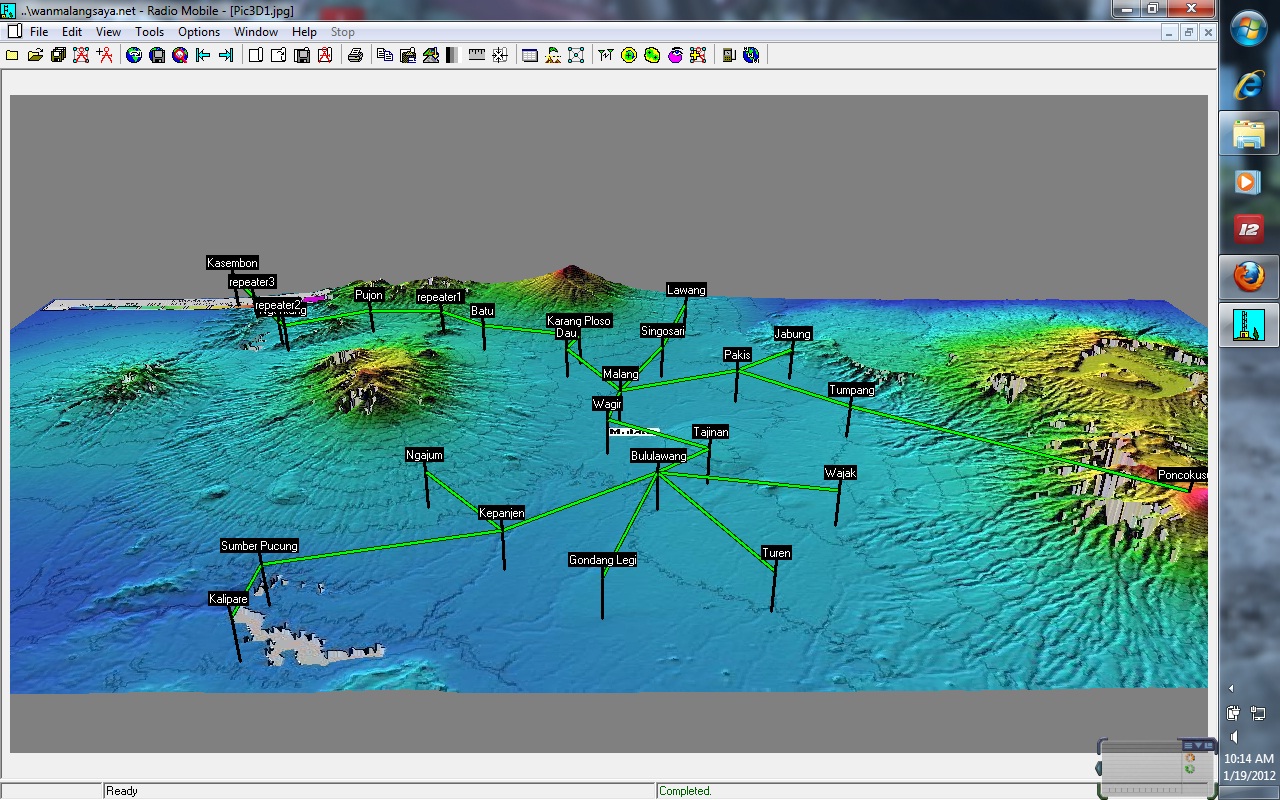
get homework from school ... I create the WAN network design in Malang, Indonesia.

This is my design

map malang radio mobile


Perda Malang
pasal 18 ayat 2 tahun 2011
region II max height tower 20-40 m
region III max height tower 90 m

Spesification network:


Area
Spesification Network
Kasembon
Tower= 65m
Frequency= 2412 Mhz
Antenna= Grid
Repeater 3
Tower= 60m
Frequency= 2412 Mhz
Antenna= Grid
Repeater 2
Tower= 72m
Frequency= 2412 Mhz
Antenna= Grid
NgantangTower= 72m
Frequency= 2412 Mhz
Antenna= Grid
PujonTower= 72m
Frequency= 2412 Mhz
Antenna= Grid
Repeater 1
Tower= 50m
Frequency= 2412 Mhz
Antenna= Grid
Batu
Tower= 50m
Frequency= 2412 Mhz
Antenna= Grid
Karang Ploso
Tower= 60m
Frequency= 2412 Mhz
Antenna= Grid
Dau
Tower= 60m
Frequency= 2412 Mhz
Antenna= Grid
Malang
Tower= 60m
Frequency= 2412 Mhz
Antenna= Omni
Singosari
Tower= 60m
Frequency= 2412 Mhz
Antenna= Grid
Pakis
Tower= 60m
Frequency= 2412 Mhz
Antenna= Grid
Lawang
Tower= 60m
Frequency= 2412 Mhz
Antenna= Grid
Jabung
Tower= 60m
Frequency= 2412 Mhz
Antenna= Grid
Tumpang
Tower= 45m
Frequency= 2412 Mhz
Antenna= Grid
Poncokusumo
Tower= 60m
Frequency= 2412 Mhz
Antenna= Grid
Wagir
Tower= 50m
Frequency= 2412 Mhz
Antenna= Grid
Tajinan
Tower= 32m
Frequency= 2412 Mhz
Antenna= Grid
Bululawang
Tower= 50m
Frequency= 2412 Mhz
Antenna= Grid
Kepanjen
Tower= 72m
Frequency= 2412 Mhz
Antenna= Grid
Ngajum
Tower= 60m
Frequency= 2412 Mhz
Antenna= Grid
Sumber Pucung
Tower= 45m
Frequency= 2412 Mhz
Antenna= Grid
Gondang Legi
Tower= 50m
Frequency= 2412 Mhz
Antenna= Grid
Turen
Tower= 45m
Frequency= 2412 Mhz
Antenna= Grid
Kalipare
Tower= 45m
Frequency= 2412 Mhz
Antenna= Grid
Wajak
Tower= 72m
Frequency= 2412 Mhz
Antenna= Grid


If
you want to design as well. You can:


Download software Radio mobile in here Radio mobile full

Download Malang map Radio mobile in here malang map

there are 22 districts with the size and height coordinates that have been standardized. You can also add your own. if still not complete.